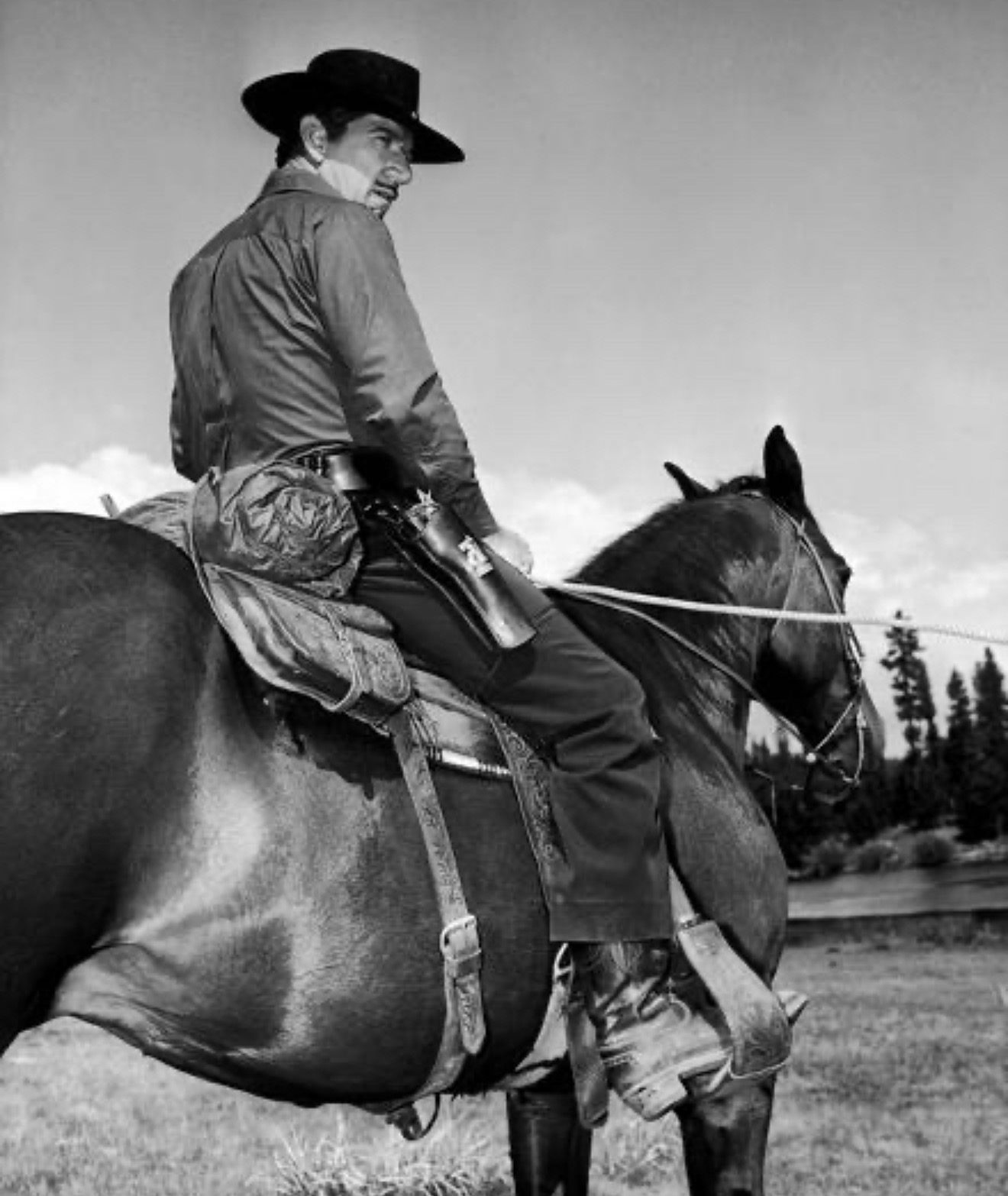
For millions of American television viewers, the sight of a mysterious gunfighter dressed in black, riding across the Old West, brings back memories of a golden age of television. But behind that unforgettable image lies a fascinating detail that even longtime fans may have forgotten.See more…
His name was Richard Boone, and his legendary character was Paladin, the central figure in Have Gun – Will Travel, one of the most memorable Western television series of the late 1950s and early 1960s.
The show premiered on CBS on September 14, 1957, and became an immediate success. It continued for six seasons, ending in 1963, and produced 225 episodes that helped establish Paladin as one of television’s most distinctive Western heroes.
But here is a surprising detail: the horse audiences associated with Paladin was not necessarily the same animal throughout the entire series. Behind the scenes, several horses were reportedly used for the role.
Their names were Curley, Frisco, Rudy, Mexico, and Rafter. Each became part of the production’s history, helping create the familiar image of a lone gunfighter traveling across the frontier.
Among those names, Rafter became the horse most closely associated with Paladin. According to the show’s published trivia, Richard Boone himself selected the name, adding a small but memorable personal touch to the character he portrayed.
Boone was more than an actor wearing a cowboy hat. He was an experienced horseman, and his ability to ride helped distinguish him from performers who depended heavily on stunt doubles for horseback scenes.
A Western production had to consider more than appearance when choosing a horse. Animals needed to cope with cameras, lights, unfamiliar locations, repeated takes, and the movement of actors and crew. A horse that remained calm was especially valuable during filming.
That practical reality helps explain why several horses could be associated with a single television character. Different animals could be used as production needs changed, while the costume, saddle, and familiar silhouette helped preserve the illusion that viewers were seeing the same trusted companion.
Another fascinating name connected with the series was Hal Needham. Before becoming a celebrated Hollywood stuntman and later a film director, Needham performed dangerous stunts in Western productions and worked on Have Gun – Will Travel.
Needham later recalled an early stunt on the series in which he had to jump from a rock roughly 30 feet high onto a moving stagecoach. It was the kind of risky physical work that helped bring the action of classic Western television to life.
Although the horse stories are fascinating, the show’s greatest achievement was the character himself. Paladin was no ordinary cowboy who solved every problem with a gun. He was educated, thoughtful, well-spoken, and often more interested in finding a peaceful solution than starting a fight.
He operated from the fictional Hotel Carlton in San Francisco, where his calling card announced his services. Clients could hire him for dangerous assignments, but Paladin sometimes turned against the very people who paid him when he discovered that they were acting unjustly.
His name was also carefully chosen. Paladin referred to the legendary knights associated with Charlemagne, reflecting the character’s personal code of honor. His black clothing, chess-knight emblem, and disciplined manner reinforced the idea that he saw himself as a knight fighting injustice in a lawless world.
One of the show’s most unusual features was the contrast between Paladin’s elegant life in San Francisco and the rough frontier communities he visited. He could enjoy fine food, literature, chess, and conversation before riding into a dangerous situation miles away.
The series also featured memorable supporting characters. Kam Tong played Hey Boy, the loyal hotel attendant who frequently helped connect Paladin with new assignments. Lisa Lu played Hey Girl during part of the show’s run, adding another familiar presence to the Hotel Carlton.
The writing helped make the series stand out, too. Gene Roddenberry, who later created Star Trek, wrote numerous episodes. The show’s willingness to explore complicated moral questions gave it more depth than a simple story about a gunfighter defeating the bad guys.
The familiar opening theme, “The Ballad of Paladin,” became another part of the show’s identity. Johnny Western performed the song, which was written by Western, Richard Boone, and series creator Sam Rolfe. Its memorable opening line helped make Paladin’s calling card famous far beyond the episodes themselves.
By the late 1950s, the series had become a major television success. It ranked among the top five programs in its first season and was consistently ranked third from 1958 to 1961, according to television-history accounts.
Yet success eventually brought fatigue. By early 1962, Boone reportedly felt that the series had run its course. Playing the same demanding role year after year was taking its toll, even though audiences continued to enjoy the adventures of Paladin.
Richard Boone died of cancer on January 10, 1981, at the age of 63. His passing marked the loss of an actor whose distinctive voice, commanding presence, and thoughtful performance had made a lasting impression on American television.
Today, the story of Paladin’s five horses offers a small but fascinating window into how classic Westerns were made. The horses may have changed, but the image of the black-clad gunfighter riding into the distance remained remarkably consistent.
For viewers who grew up watching Have Gun – Will Travel, these details are more than trivia. They are reminders of Saturday nights, black-and-white television, unforgettable theme songs, and a time when a well-written Western could make audiences think as well as cheer.