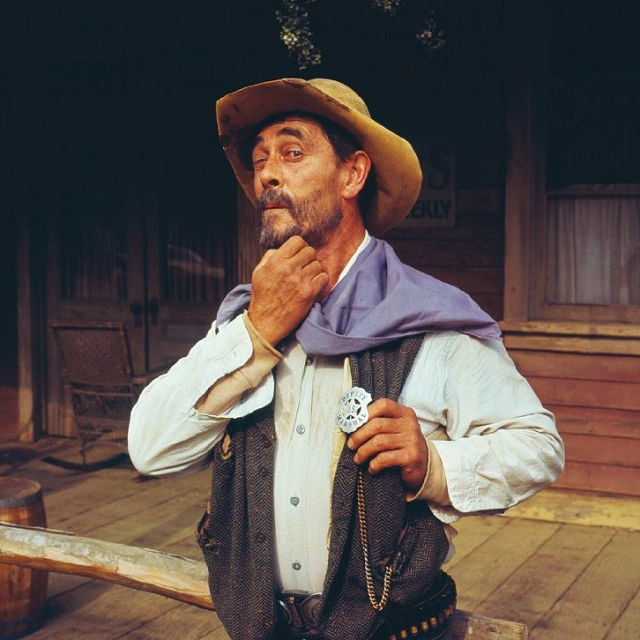
On April 28, 1991, the Western world lost a familiar face — a character actor whose voice, appearance, and unforgettable presence had become part of television history.See more…
His name was Ken Curtis, the beloved actor behind Festus Haggen on Gunsmoke. He was 74 years old when he died at his home near Fresno, California, leaving behind a career that stretched across movies, television, music, and some of Hollywood’s most memorable Westerns.
Just one day before his death, Curtis had attended a rodeo in nearby Clovis. It was a fitting final public appearance for a man whose life had been so closely connected to the American West.
For millions of Gunsmoke viewers, his passing felt strangely personal. After years of watching Festus walk the streets of Dodge City, argue with Doc Adams, and stand beside Marshal Matt Dillon, audiences had come to think of the character as more than just another television personality.
Curtis joined Gunsmoke during its long television run and transformed Festus Haggen into one of the show’s most recognizable characters. With his scruffy beard, unusual walk, squinting eyes, rough clothing, and unmistakable voice, Festus looked as though he had stepped directly out of another era.
But the character was much more than comic relief. Festus could be funny one moment and fiercely loyal the next. When trouble arrived in Dodge City, he was willing to stand beside Matt Dillon and the others, no matter how dangerous the situation became.
That balance became one of the reasons audiences remembered him. Festus was rough around the edges, stubborn, suspicious, and often argumentative, but underneath it all was a man with a strong sense of loyalty. Curtis understood that the character needed a heart, not just a funny voice.
Perhaps some of that authenticity came from Curtis’s own childhood. Born Curtis Wain Gates in Lamar, Colorado, he grew up around people and situations that were far removed from the polished Hollywood world he would later enter.
His father became a sheriff, and Curtis spent part of his childhood around the Bent County jail. His mother even cooked meals for the prisoners. Lawmen, prisoners, drifters, and rough characters were therefore not simply fictional figures he encountered in a screenplay years later.
Curtis later explained that part of Festus was inspired by a man from his childhood known as Cedar Jack, a cedar fence-post cutter who sometimes found himself in his father’s jail. Those memories helped give Festus a natural quality that audiences could feel, even when they could not explain exactly why the character seemed so believable.
Before television made him famous, Curtis had already built a career in music and film. He became a professional singer and worked with the legendary Tommy Dorsey orchestra before eventually becoming associated with the Sons of the Pioneers, one of the most famous Western singing groups in American history.
His musical background also influenced the way he performed Festus. Curtis understood timing, rhythm, pauses, and the importance of a distinctive delivery. Every unusual phrase and stretched-out word seemed to have its own rhythm, making Festus instantly recognizable even when viewers could not see him.
Hollywood also gave Curtis the opportunity to work with legendary director John Ford. He appeared in several Western films, including The Searchers, working alongside some of the biggest names in the genre.
Those experiences helped shape the Western persona audiences would later see on Gunsmoke. Curtis understood the atmosphere of the genre, but he also understood that the most memorable characters needed to feel like real people rather than simple stereotypes.
When Curtis brought Festus to life, he created an entire physical language for the character. The beard scratching, the suspicious looks, the awkward stance, the sudden temper, and the unusual walk all became part of a performance that could be recognized almost instantly.
Yet there was always another side to Festus. Behind the humor was loyalty. Behind the strange expressions was experience. And behind the rough exterior was someone who cared deeply about the people around him.
Curtis remained associated with Gunsmoke for many years, becoming one of the faces most closely identified with the series. For generations of viewers, hearing his voice was enough to bring back memories of Dodge City, Matt Dillon, Doc Adams, and the world of classic television Westerns.
He never seemed to treat Festus as a character who needed to be escaped or forgotten. Curtis once expressed his affection for the show by saying that he had enjoyed every minute of every day and would not have minded if it had continued for many more years.
That affection helps explain why the character has endured. Curtis did not simply play Festus as a joke. He created a person with history, personality, flaws, humor, courage, and loyalty — someone audiences could laugh with and still believe would stand beside them when things became serious.
More than three decades after his death, old episodes of Gunsmoke continue to bring that character back to life. The moment that familiar voice comes from the streets of Dodge City, viewers who grew up with the series can instantly recognize him.
He may be gone, but Festus Haggen remains one of the unforgettable figures of classic Western television. And behind that unforgettable character was a performer who gave him something that could never be copied — his own voice, his own memories, and his own unmistakable way of bringing the American West to life.
There will never be another Festus Haggen. There was only one Ken Curtis.