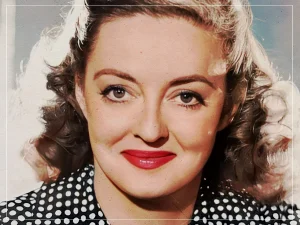

Credit: Far Out / Alexander Kahle
Art shouldn’t have to be a competition, but for decades, award ceremonies have left actors fighting against one another to be crowned the greatest of their craft, something which, when it really boils down to it, is rather arbitrary.
How do you determine the best performance of the year when there are so many movies, so many different kinds of performance styles, and, ultimately, personal preference at play?
Yet even some of Hollywood’s biggest stars have found themselves getting fiercely competitive when it comes to awards season. Stars such as Bette Davis. The actor was an icon, known for her incredibly nuanced performances, often presenting a rather bold and uncompromising view of femininity in all of its complexities. Getting her start when she was in her early 20s, Davis made her screen debut in 1931 with Bad Sister, and by 1936, she’d won her first Oscar for Dangerous. Just three years later, she had another one up her sleeve for the film Jezebel.
Then came her stint as a nominee in the ‘Best Actress’ category five years in a row, making her the first star to achieve such a feat. Four more nominations would come over the rest of her career for the likes of Now, Voyager and All About Eve, with her final nomination coming in 1963 for the most unhinged performance she’d ever given in Whatever Happened to Baby Jane?.
You’d think that with two Oscars already under her belt, she wouldn’t be fazed by missing out on others, but perhaps it was the fact that this was the eighth nomination she’d failed to win – 24 years on from her last win – that left her feeling bitter. In particular, she wasn’t keen on losing out to someone who’d already had extensive experience playing their character on stage before bringing them to the silver screen.
For her performance in the classic psychological horror film, which featured Davis and her long-time rival Joan Crawford, the actor was up against Katharine Hepburn, Lee Remick, Geraldine Page, and Anne Bancroft. The Oscar went to Bancroft for her performance in The Miracle Worker, which didn’t sit well with Davis. Bancroft had already played the character of Anne Sullivan, the tutor who helped Helen Keller, on Broadway between 1959 and 1961.
Bancroft had worked with the same director, Arthur Penn, and the same actor, Patty Duke, as Keller, so Davis felt her win was unjust. She’d already had years of practice and familiarity with the role – how was that fair?
Further reading: Cutting Room Floor
“There are certain performances that are suitable for an Academy Award, and when I lost out with Jane, never had I had a shock like that before,” she said.
It was simple enough for the actor. “I did feel that someone who had done a play for that many years, it’s not that big an accomplishment as starting from scratch on the screen and play the character, so I was a little bitter,” she explained.
Perhaps Davis knew that she wasn’t going to have many more chances to win an Oscar in her career, which makes sense considering that she didn’t earn another Academy Award nomination after that, and that’s why she was so upset to lose out.