For most audiences, Joanna Moore is remembered as a beautiful, talented actress from Hollywood’s classic era.
The blonde hair.
The poised smile.
The supporting roles.
The television appearances.
The glamour.
But behind that image was a life far more painful than the publicity photographs ever suggested.
Childhood tragedy.
A family lost in a car crash.
Deafness.
Addiction.
A turbulent marriage.
The loss of custody of her children.
Financial collapse.
And a long personal decline that unfolded while her daughter, Tatum O’Neal, was becoming one of the most famous young actresses in America.
For years, Hollywood presented Joanna Moore as another elegant performer trying to make her way through the studio system.
Her daughter later described something much darker.
A woman who had been carrying trauma long before Hollywood ever discovered her.
Joanna Moore was born Dorothy Joanne Cook in Georgia in 1934.
Her childhood was shattered at an early age.
When she was still a little girl, a devastating automobile accident killed her parents and younger sister.
In a single moment, her immediate family was gone.
For a child, that kind of loss is almost impossible to measure.
She was later taken in by relatives and eventually adopted.
Her name changed.
Her surroundings changed.
Her life changed.
But the trauma remained.
Years later, Hollywood would see a polished young actress.
Very few people understood what had already happened before she ever stepped onto a movie set.
Moore briefly attended college and married young.
That first marriage did not last.
She eventually moved to California and began pursuing acting.
Hollywood noticed her quickly.
She was attractive.
Photogenic.
And capable of fitting into the kinds of supporting roles studios were constantly filling.
Universal signed her.
Then came film and television work.
One of her most notable early appearances was in Orson Welles’ Touch of Evil.
She also appeared in Westerns, crime dramas and television series.
For a time, everything seemed to be moving in the right direction.
But the career never developed into the level of stardom that might have seemed possible.
There were good roles.
Then smaller ones.
Television work.
Guest appearances.
Periods of momentum followed by long stretches of uncertainty.
That inconsistency can be brutal in Hollywood.
A performer can feel successful one year and almost forgotten the next.
For Moore, that professional instability became even harder because of what was happening physically.
She began losing her hearing.
The condition was otosclerosis, a disorder affecting the bones of the middle ear.
For an actress, hearing loss can be devastating.
Dialogue depends on timing.
Cues matter.
Directors give instructions.
Scenes shift quickly.
And suddenly, Moore was trying to work inside that environment while increasingly unable to hear the people around her.
She adapted.
She learned to read lips.
She watched other actors closely.
She relied on visual signals.
From the audience’s perspective, nothing seemed wrong.
That alone says something about her determination.
But working that way took enormous effort.
Eventually, surgery restored much of her hearing in the early 1960s.
It should have been a fresh start.
Instead, another complicated chapter was beginning.
Moore married actor Ryan O’Neal in 1963.
They had two children.
Tatum and Griffin.
From the outside, the marriage looked glamorous.
Two actors.
A growing family.
Hollywood connections.
But behind the public image, the relationship was unstable.
Tatum O’Neal would later describe a childhood marked by chaos, substance abuse and emotional turmoil.
Moore struggled with addiction.
The marriage deteriorated.
Arguments became part of family life.
The home environment grew increasingly unpredictable.
Eventually, Joanna and Ryan divorced.
The children were caught in the middle.
This is where the story becomes especially painful.
Moore’s struggles with alcohol and drugs became severe enough that she eventually lost custody of Tatum and Griffin.
For any parent, that is devastating.
For Moore, it also created a strange inversion.
She had entered Hollywood seeking success.
Now her family was being pulled apart under the same system’s glare.
Then something else happened.
Tatum became famous.
Very famous.
In 1973, at only ten years old, Tatum O’Neal starred alongside her father in Paper Moon.
Her performance won her the Academy Award for Best Supporting Actress.
She became the youngest competitive Oscar winner in history.
Imagine the contrast.
Joanna Moore had spent years trying to survive Hollywood.
Her daughter arrived and achieved, almost instantly, a level of recognition Moore had never reached.
That kind of situation could create pride.
It could also create pain.
And Tatum’s later recollections suggest the family dynamic remained deeply troubled.
Fame did not heal them.
Money did not heal them.
Awards did not heal them.
The emotional damage already existed.
Joanna’s own career continued to fade through the 1970s.
Her personal life became increasingly unstable.
Addiction worsened.
Finances became difficult.
She struggled to maintain the kind of steady work that had once seemed possible.
Then came another physical trauma.
Moore lost three fingers in an accident.
For someone who had already survived hearing loss, family tragedy and addiction, it was another brutal setback.
By this point, the glamorous Hollywood image had largely disappeared.
The actress audiences remembered from polished studio productions was living a much harder reality.
And that is the reality Tatum O’Neal later helped reveal.
Her mother’s life was not simply a story of career decline.
It was a story about what happens when unresolved trauma follows someone into an industry that rewards appearance, productivity and emotional control.
Hollywood wanted Joanna Moore to look composed.
Life gave her very little reason to feel that way.
She had lost her family as a child.
She struggled with hearing loss.
She moved through a volatile marriage.
She battled addiction.
She lost custody of her children.
Her daughter’s success unfolded while Moore’s own life was unraveling.
And through much of it, the public only saw fragments.
A movie credit.
A television guest role.
A photograph.
A glamorous face.
That is the danger of celebrity mythology.
It compresses people into images.
The troubled childhood disappears.
The hearing loss disappears.
The addiction disappears.
The fear disappears.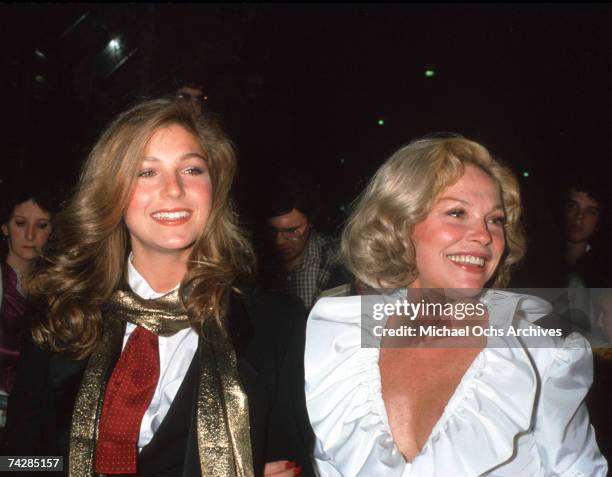
All that remains is the finished performance.
But Joanna Moore’s finished performances were created by someone fighting battles audiences could not see.
Her later years did not bring a dramatic comeback.
There was no great Hollywood redemption story.
No triumphant return.
Instead, her health declined.
In 1996, Moore was diagnosed with lung cancer.
By then, decades of physical and emotional strain had already taken a toll.
She died in November 1997 at the age of 63.
For the public, it was the death of a former Hollywood actress.
For Tatum and Griffin O’Neal, it was the end of a much more complicated relationship.
Children can love a parent and still carry pain from what that parent was unable to give them.
Tatum’s later reflections have often been marked by exactly that kind of complexity.
Joanna was not simply a villain.
She was not simply a victim.
She was both damaged and damaging.
A woman shaped by tragedy who later became part of her children’s own trauma.
That is what makes her story difficult.
And human.
It would be easy to reduce Joanna Moore’s life to addiction.
That would miss too much.
She had talent.
She worked hard.
She adapted to hearing loss in a profession built around spoken performance.
She survived childhood tragedy most people could hardly imagine.
She built a career in an industry that discarded women quickly.
But survival itself does not guarantee stability.
The pain accumulated.
The consequences spread.
Her children experienced them.
Hollywood experienced only the version she was able to perform.
That difference matters.
At 62, Tatum O’Neal’s perspective on her mother is not simply about exposing old secrets.
It is about understanding what existed behind the image.
Joanna Moore had been photographed as glamorous.
She was promoted as beautiful.
She was presented as successful.
But none of that could protect her from grief, illness, addiction or family collapse.
And perhaps that is the real reality of Hollywood her daughter revealed.
The camera only records what happens after someone is ready.
It does not show the childhood trauma.
It does not show the arguments at home.
It does not show the pills.
It does not show the nights when a career feels like it is disappearing.
It does not show the children learning to survive instability.
The finished image can look perfect.
The life behind it can be falling apart.
Joanna Moore spent years trying to become part of Hollywood.
Hollywood gave her visibility.
It gave her work.
It gave her a name audiences remembered.
But it could not heal the wounds she carried into it.
And by the time her daughter became famous enough to tell her own story, the polished version of Joanna Moore had already faded.
What remained was something much harder.
The truth that a beautiful public life can hide a deeply broken private one.
And sometimes the people who understand that truth best are the children who had to live inside it