The body of Christina Onassis, 37, was found Saturday morning in the bathroom of a weekend house at the Tortuguitas country club, approximately 20 miles north of Buenos Aires, Argentina, where she had been staying with her friend, Marina Dodero. The woman who inherited one of the world’s greatest shipping fortunes, who had been married four times before her 34th birthday, was pronounced dead at a private clinic shortly after being discovered. An autopsy performed by Argentine medical examiners concluded that she died of a heart attack caused by acute pulmonary edema, with no evidence of suicide, 𝒹𝓇𝓊𝑔 overdose, or foul play found at the scene.
The news flashed across the globe within hours, and the wire services that had chronicled her life for nearly two decades immediately began assembling the obituaries that would define her legacy. The Associated Press described her as the heiress whose frequent bouts with obesity were widely reported, while United Press International noted that she had been married four times, with the three marriages preceding her final one lasting less than four years combined. The numbers attached to her fortune varied wildly in these accounts, with estimates ranging from $200 million to $1 billion, but every single report agreed on the central tragedy of her existence: she had been born into unimaginable wealth and had died without ever finding the happiness that money was supposed to buy.
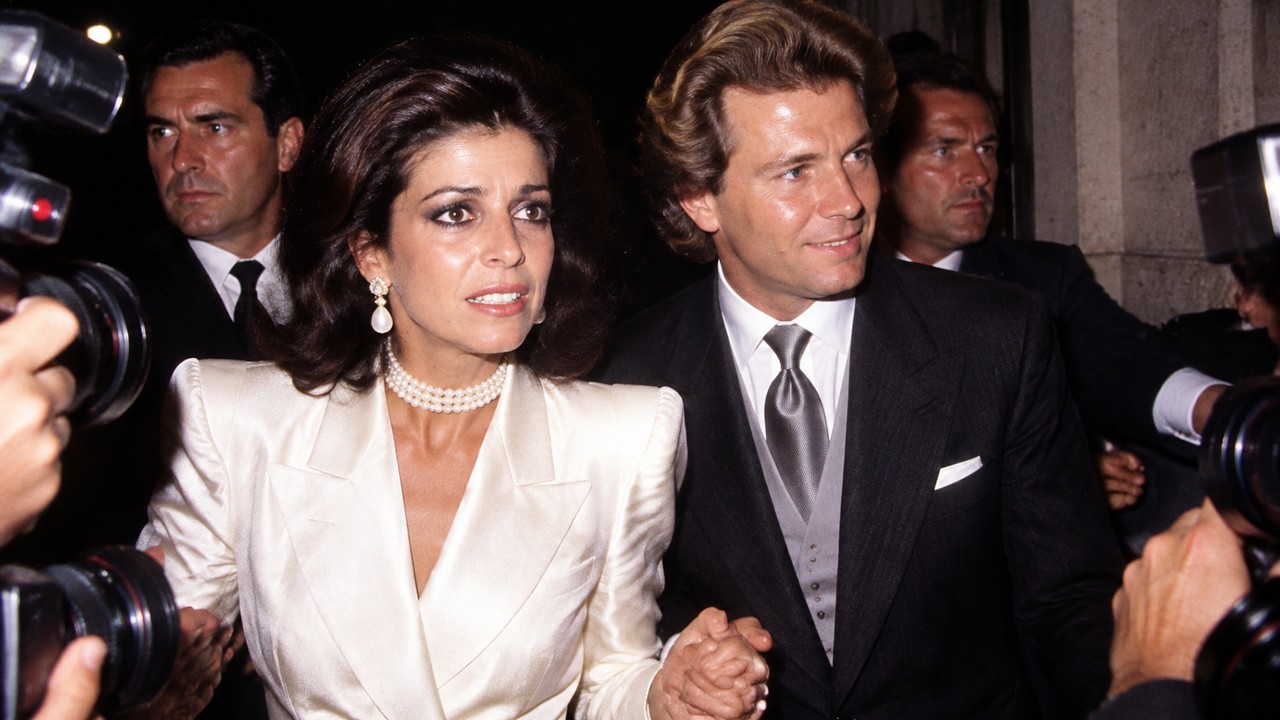 The circumstances of her final days are now coming into sharper focus, and they paint a portrait of a woman who was, by her friend’s own account, preparing to marry for a fifth time. Marina Dodero, the wife of the administrator of Christina’s estate, later told the Argentine magazine Ola that Christina was about to marry her brother, Jorge Chumlju. The wedding never took place.
Instead, the heiress who had told reporters in Paris in March of 1984 that she wanted to start a family right away was found dead in a bathroom, leaving behind a three-year-old daughter, Athena, who was not present at the funeral but sent a cross of pink roses to be placed on her mother’s grave.
To understand how a woman with every material advantage could end up alone in a Buenos Aires bathroom, it is necessary to go back to the beginning, to a childhood that was defined by the collision of two shipping dynasties and the ruthless logic of the families that built them. Christina Onassis was born on December 11th, 1950, at the Loys Sanitarium in the Lennox Hill neighborhood of Manhattan, the daughter of Aristotle Onassis and Athena Levanos, known to everyone as Tina. Her father was one of the richest men alive, a Greek ship owner who had clawed his way into the upper echelons of international finance, and her mother was the daughter of Stavros Levanos, another shipping magnate whose fortune rivaled her husband’s.
The girl was born where two shipping dynasties met, and her father called her Chrysomou, which in Greek means my golden one.
The childhood behind that name was one of constant movement, shuttling between France, Greece, and England, with education provided by expensive finishing schools and dancing lessons under Margot Fonteyn. A biography of her father published by five investigative reporters from the London Sunday Times in 1977 described her emergence from this upbringing in terms that the Associated Press would quote again at her death: she emerged a good linguist, but with no sense of place, and as it turned out, very little say over her own future. The world she was born into had firm rules about daughters, and those rules dictated that a daughter’s marriage was a matter for the family, a move on a board where fortunes were consolidated and rivalries were settled.
Her own mother was the living proof of this system. Tina Levanos had married Aristotle Onassis on December 28th, 1946, when she was 17 years old and he was 40, a match that by one account of his life was seen by Onassis as more than a marriage, a blow dealt to his father-in-law and to the old-money Greek families who held him in low esteem. The marriage produced two children, Alexander in 1948 and Christina two years later, but it did not survive the pressures of the world that created it.
The couple divorced in 1960 after Onassis’s 𝒶𝒻𝒻𝒶𝒾𝓇 with the opera singer Maria Callas, and eight years later, he married Jacqueline Kennedy on his island of Scorpios, with his 17-year-old daughter standing among the guests.
By then, Christina was old enough to understand what marriages in her family were for. Her first serious romance had followed the rules, with Time magazine later recalling that her first important romance was with Peter Goulandris, the heir to another Greek shipping fortune. On paper, it was exactly the kind of match the system approved, a shipping daughter and a shipping son, but in practice, Time wrote, the couple were so incompatible that they never got as far as the altar.
So she chose for herself, and the man she chose was Joseph Bolker, a real estate developer from Los Angeles who was nearly twice her 20 years, a man outside the shipping families, outside Greece, outside the board on which daughters were moved.
The wedding took place in Las Vegas in late July of 1971, and Time magazine printed a single line about it in its Milestones column, noting that the groom was a builder in Southern California, that it was her first marriage and his second. Her father did not turn the page. Aristotle Onassis was furious, and he had at his disposal the one weapon a 20-year-old heiress could not match: the fortune itself.
By the account of William Wright, who published a biography of Christina in 1991 called All the Pain That Money Can Buy, three things about Joseph Bolker set her father against him: his age, his Jewish background, and the fact that Aristotle Onassis had not chosen him. According to Wright, those three facts inspired a fierce campaign by the father to smear Bolker’s name with his daughter.
The pressure came from every side at once. Christina turned 21 on December 11th, 1971, five months into the marriage, and by the account of her father’s biographer, Peter Evans, trust money was due to her on that birthday, and her father delayed it. The same summaries attribute a line to one of his representatives said to Bolker directly: as long as she remains married to that man, she doesn’t get a penny.
Her mother’s part in the story is told in pieces, with one encyclopedia saying plainly that both parents opposed the marriage, while a popular account that follows Wright offers a different picture of Tina, saying she gave the young couple $200,000 to buy a beach house in California. The marriage lasted nine months, about the length of time it took her father’s displeasure to finish what it started, and Time dated its divorce notice to May 15th, 1972, with the memorable phrase: displeased Papa Aristotle.
The first marriage had been broken by her father’s money, but within three years, the father who fought it and nearly everyone else in her family would be gone. On January 23rd, 1973, Alexander Onassis died in an Athens hospital of injuries from an air crash the day before, age 24. He was her only sibling, two years older, the son their father had meant to inherit the empire, and his death broke Aristotle Onassis, who refused to accept that it had been an accident and offered a reward of $1 million for proof of deliberate action.
The weight of the succession now swung onto the daughter, and she was sent to New York City to work in her father’s office, pulled to the center of the empire without time to grieve because the empire did not stop for grief.
Then her mother died. Tina Levanos died in Paris on October 10th, 1974, at the Hotel de Chanel, the mansion she shared with her husband Stavros Niarchos, at the age of 45. The pathologists recorded an acute edema of the lung, though other accounts attribute her death to a 𝒹𝓇𝓊𝑔 overdose, and the sources have never agreed.
Tina left her daughter an estate valued at $77 million, and Christina later sued Niarchos for her mother’s estate estimated at $250 million in the money of 1974, claiming that under Greek law, the marriage should be annulled. She later withdrew the suit, and by the same account, Niarchos returned all of his wife’s money to her along with her jewelry, her artwork, and her other personal effects.
 The third death came the following spring. Aristotle Onassis collapsed outside Athens in early February of 1975 and was flown to the American Hospital of Paris at Neuilly, where he died on March 15th, 1975, of bronchial pneumonia according to the Associated Press, with his daughter close by in Paris. He was buried on Scorpios, his island where his son already lay.
Within a period of 29 months, Christina had lost her entire immediate family: a brother in January of 1973, a mother in October of 1974, a father in March of 1975. She had been 22 at the first funeral and 24 at the last. People magazine writing after her death reported that when her father died she lamented, I am all alone in the world now.
A Greek newspaper preserved a fuller version said shortly after the funeral: I cry constantly. I lost them all. My father, my mother, Alexander.
I am completely alone.
And suddenly, one of the richest women in the world was completely alone, with the two facts arriving together and never being separated from each other again. Four months after the last funeral, on July 22nd, 1975, in a private chapel in the seaside Athens suburb of Glyfada, Christina Onassis married for the second time. She was 24 years old, and the groom was Alexander Andreadis, 30, the son of a banker and industrialist, Professor Stratis Andreadis.
Time magazine reported that the two had known each other for about a month and had been engaged for about a week, and the magazine reported that the men who oversaw the Onassis empire had picked the groom themselves. One friend, as the report relayed it, called the whole thing an arranged marriage. The bride, by Time’s account, arrived 45 minutes late to her own wedding.
On paper, the second marriage looked like the kind of match the system had been built to make: Greek to Greek, shipping to shipping, fortune to fortune. But the Andreadis family’s own fortune was in trouble that same year. In 1975, the Greek government nationalized the domestic businesses of the Andreadis group, and by the account of William Wright, it emerged after the wedding that the groom wanted $20 million from his wife who had just come into her inheritance.
Christina, Wright wrote, had hoped that a man from a family fortune of his own would never want hers. Now, by his account, she was convinced that she had married a gold digger. The marriage lasted a little more than a year, and the groom, who had compared his marriage to a crown, Time wrote, was dethroned by divorce less than two years afterward.
Between her second divorce and her third wedding, Christina Onassis did the thing her father had trained her for: she ran the business. After her brother’s death, her father had sent her to work in his New York office and groomed her as his successor, and after his death, she took over the fleet and ran it from Monte Carlo through the company called Olympic Maritime. By one encyclopedia’s reckoning, she was now, at 24, the richest woman in the world.
The first fight was over the will itself, with her father’s widow, Jacqueline Kennedy Onassis, pressing a claim that was settled in 1977 for a sum estimated to be between $20 million and $26 million, about twice what the will would have given. With this deal, her attorney said, Christina came of age.
The business took her, in 1976, somewhere no Onassis had been expected to go. Olympic Maritime was negotiating a contract with the Soviet Union to carry grain from Canada to the Soviet Union in chartered tankers, and on the Soviet side of those talks was a shipping official of the state chartering agency Sovefracht. His name was Sergei Kauzov.
Time magazine called the romance that followed beyond doubt the year’s strangest love match. In the first week of August 1978, the magazine told its readers that Christina Onassis, 27 years old, was in Moscow and that she meant to marry a Soviet citizen. The citizen was Kauzov, 37, a slender, quiet man with thinning blonde hair, a man who worked for a state agency and who had a wife and a nine-year-old daughter.
The wedding came on August 1st, 1978, a civil ceremony at a Moscow wedding palace, with more than 300 journalists from around the world gathered outside and none of them let in. Afterward, by the accounts that reached the Western papers, the couple moved into his mother’s small apartment of two rooms, and one of the richest women in the world shared a bathroom with her husband and her mother-in-law. From the start, the West wanted to know one thing about the man she had married: was he working for the KGB?
The question followed him for the rest of the marriage, and it has never been answered. The loudest version came in March of 1980 when the marriage was already ending, with the Daily Express printing on its front page that Kauzov was a Soviet agent who wooed and won the heiress on KGB orders to gain confidential information on Western oil supplies.
The marriage lasted about 16 months, and the divorce came the next spring in Switzerland. The lawyers spoke for the couple, with one Swiss lawyer reporting that they did not part in anger, and by Time’s account, a settlement reportedly worth millions of dollars eased the blow. When she died, UPI reported that she had given him a ship in the settlement, while Russian retellings say two tankers and an apartment in London.
Even at the low end, it cost her a ship. Then she was alone again, and she went back to work, running the fleet her father had left her from Monte Carlo. In 1982, she became the first woman elected to the board of the Greek Union of Ship Owners, a world of shipping families that had not had a woman at its table before her.
 The engagement to Thierry Roussel was announced on February 23rd, 1984, at a party in a Paris nightclub. United Press International described him as an executive at a top French modeling agency, and it reported that the wedding was expected in May. It did not wait for May.
On Saturday, March 17th, 1984, Christina was married twice in a single day in Paris, a civil ceremony at the town hall in the morning and a Greek Orthodox service in the afternoon, with a security detail that the wire report counted at about 40 guards holding the photographers back. The bride was 33 years old, and the groom was 31, an heir to a large pharmaceutical company who led a major modeling agency in Paris and a dozen smaller businesses besides. United Press International put the turnover of his business interests at an estimated $125 million a year.
On paper, the fourth match looked like the safest of the four. This groom was not a man more than twice her age chosen against her father, not the son of a falling banker, not a Soviet official whose government might be listening. He came from money, from Paris, from her own world.
The wire report added a line that reads very differently now: according to United Press International, she had told reporters that she wanted to start a family right away. By the account of her biographer, William Wright, the two had first met about a decade before the wedding, and Roussel had been open with her from the start about one thing: he had told her that he was in love with a Swedish model, Gaby Landhage, with whom he was living. Wright’s account also records what she did not know: she did not know, by his telling, that the relationship with Gaby continued after the wedding.
On January 29th, 1985, at the American Hospital at Neuilly outside Paris, Christina Onassis gave birth to a daughter. She named the child Athena after her own mother, Tina Levanos, whose given name had been Athena, too. It was her only child, and the papers would soon call the baby the richest little girl in the world.
Count the months as the record lays them out, because the dates do the work that no adjective can. The engagement party came on February 23rd. The double wedding came on March 17th, behind about 40 guards.
The daughter came on January 29th, 10 months after the wedding. And in July of 1985, about six months after Athena was born, Gaby Landhage gave birth to a son, with the published account of Roussel’s family giving the boy’s name as Eric and giving Roussel as his father.
Two children in the same year by the same man to two different mothers. The encyclopedia version is that the marriage ended after she discovered that her husband had fathered a child with his longtime companion during it. By the account of William Wright, as the Greek newspaper To Vima retold it, for every night Roussel spent with her, she gave him $100,000.
There is no contract for it in the record, no bank statement in any archive a viewer could open, but there is a biographer’s claim repeated in later press, and there is the shape of a life that makes the claim hard to dismiss. A woman who had been told all her life in one form or another that men wanted the money had arrived by this telling at the point of handing it to her own husband in exchange for his company.
The marriage went on after a fashion around the other family. In the summer of 1986 by Wright’s account, Christina spent time in Monaco with Gaby Landhage and Gaby’s child, the wife and the mistress with a child each by the same man spending part of a summer in the same place. In May of 1987, the published record of Roussel’s family shows Gaby Landhage gave birth to a second child by him, a daughter named Sandrine, the second of their children born while he was married to Christina.
The marriage ended that year, and by Wright’s account, as To Vima relayed it, it was Roussel who asked for the divorce, and she accepted his request on terms favorable to him. By the encyclopedia account, she divorced him after discovering that he had fathered a child with his mistress during the marriage.
What followed is described in the press of the time and in the obituaries that came later, always at a remove. A Chicago newspaper’s later retrospective put it in one sentence: she reportedly treated herself with drugs and food as a way of dealing with the betrayal. The encyclopedia account says she had been diagnosed with clinical depression at the age of 30 and prescribed barbiturates, amphetamines, and sleeping pills to which she developed an addiction.
Around the loneliness, the money ran in strange directions, with Wright reporting $30,000 to send a private jet to America to keep her supplied with Diet Coke, a helicopter sent from Austria to Switzerland to fetch a David Bowie cassette, and friends paid as much as $30,000 a month to keep their time free for her. The Daily Mail reported that she drank about 20 cans of Coca-Cola a day.
Then came the summer of 1988. By Wright’s account, as To Vima told it, she rented the Villa Trianon on the French Riviera that summer and moved there with Athena, who was three. The heiress was noticeably thinner by that telling, and doing her best to look as radiant as possible.
Paparazzi photographed her by the villa’s pool with Roussel, and there, by Wright’s account, she made him an offer. She offered him $10 million to father another child with her, to give their three-year-old daughter a brother or sister. Roussel refused, according to the article.
Set the figures side by side, every one of them reported and none of them proved, and the shape of her last years appears: $100,000 a night for a husband’s company by the biographer’s telling, $30,000 for a single flight to fetch a soft drink, $30,000 a month to keep a friend’s diary clear, about 20 cans a day, $10 million for a second child, offered and refused.
 Every number is a price put on something that is supposed to have no price at all. Lay the four marriages next to each other, and the prices change shape without ever going away. Her father’s money had been held over the first husband by one biographer’s telling.
The second husband, by another account, had wanted $20 million. The third left by the reports of the settlement with at least a ship. The fourth, by Wright’s account, was paid by the night.
Only the direction of the money changed. At the start, it was used to keep a man away from her. At the end, it was offered to keep one near.
We saw the photographs by the pool. We saw that she was thinner and the magazines told us she looked well. We did not see the offer or the refusal or the summer that followed it.
That autumn she flew to Argentina to a friend’s house in the country, and by the friend’s own later account, to a man she was about to marry. She was found dead on November 19th, 1988, and the autopsy found that she had died of a heart attack caused by acute pulmonary edema, with no evidence of suicide, 𝒹𝓇𝓊𝑔 overdose, or foul play. Judge Juan Carlos Cardonali said the medical examiners found nothing that would indicate the cause of death was from other than natural causes, though he could not rule out the role of some chemical element such as barbiturates or amphetamines, and organs were kept for further tests.
Weeks later, the Greek press reported that the tests had found barbiturates, but that report stands against the first finding, and neither the family nor the official record ever called her death anything but natural.
She was buried on Scorpios in the family plot beside her father and her brother. United Press International counted about 5,000 mourners in Athens and about 80 at the burial on the island. Athena, three years old, was not there.
She sent a cross of pink roses. The fortune went to Athena, with Christina having chosen trustees to manage it if she died, four Greek trustees whom the press would later dub the Greybeards, and Thierry Roussel. By one account of the arrangement, she never trusted Roussel completely, which is why the family set a board over the money until the child came of age.
In 1990, by the encyclopedia’s account, Roussel married Gaby Landhage in a village church near Chambord, and by then, the same account says Athena was in her father’s custody, and she was a bridal attendant at the wedding.
So, did any of the four men marry her rather than what came with her? The record cannot answer that for every husband, and it would be dishonest to pretend it can. What the record does show is who stood beside each wedding: her father with the trust money beside the first, a family’s fortune and a falling bank by every account beside the second, an estate and the whispers about its intelligence service beside the third, and beside the fourth, by her biographer’s telling, a price by the night.
It was not bad luck in love. It was a fortune that made every marriage a negotiation set by someone else every time. We read the notices.
We read the line in Time when she was 20 and the line about seeking divorce when she was 29 and the line about obesity when she was dead. We bought the magazines with the wedding photographs and we never asked who had arranged the wedding.
She did not stop marrying. She kept going back. She did not give up on a family.
She had a daughter and then she tried, by one account, to give that daughter a brother or sister. She did not stop believing that someone might want her for herself. She was, by her friend’s account, about to marry again when she died.
We watched her wait. We counted her husbands. We called her unlucky.
And we called her the poor little rich girl. And we never once asked what it costs to be loved by people who are looking past you at the money. A former executive of her own company, Olympic Maritime, put it in a single sentence after her death: she may have had hundreds of millions of dollars, but she never really had a chance in life.
In Paris in March of 1984, she had needed about 40 guards to keep the cameras away from her wedding. The cameras waited. In the end, they were the ones who wrote the last line about her marriages, and it was the only line anyone ever printed in full.